When I was a child, my parents had a small boat with which we toured the Tyrrhenian coast far and wide. I loved being on the boat, meeting people in the ports and swimming in the crystal clear waters of the islands of Ponza and Palmarola. The port of departure for our adventures was Anzio, close to Roma, and it was there that my father met Cesaretto, a skipper who cooked divinely.
Many years have passed, but I still remember his wonderful soup. He had a secret ingredient: he enriched it with moray eel. Hours and hours milking the moray eel to make the thorns go down the tail…
Unfortunately, I don’t have his recipe; this is the one I use and I make especially for dinners with guests, since it takes some time to prepare.
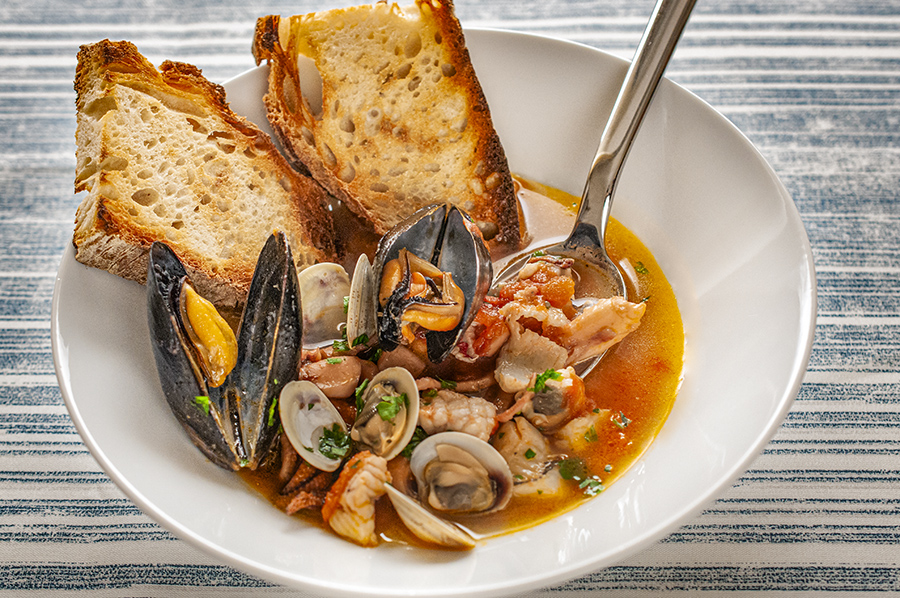
Fish soup Anzio's style
- Preparation time: 180 minutes
- Ingredients for 6 servings
- Difficulty: Average difficulty recipe
- Ingredients
- 1 lb or 400 g of baby octopus
- 1 lb or 400 g of cuttlefish
- 12 oz or 300 g of mussels
- 1 lb or 400 g of clams
- 3 lb or 1.2 kg of soup fish (scorpion fish, crock, dogfish, marble)
- 2 anchovies in oil
- 1/2 glass of dry white wine
- 8 fresh San Marzano tomatoes
- 1 clove of garlic
- 1 carrot
- 1 onion
- 1 piece of celery
- Extra virgin olive oil to taste
- Chili pepper to taste
- Parsley leaves to taste
- Salt to taste
- Instructions
- Prepare the clams. Throw away any broken clams and allow the remaining clams to drain for at least three hours in very cold “sea water.” Sea water is made with 2 tablespoons of salt for every liter or US quart of cold water and is mixed well until fully dissolved.
Once the purging time is over, lightly tap every single clam on a surface or a chopping board to select the good ones from those that are only full of sand. - Prepare the mussels. Clean them well by removing the beard and scratching the shell with a steel sponge to remove any impurities; rinse well in running water.
- Clean the baby octopus. Rinse them under running water, also spilling the bag of the head to eliminate any membrane residues; eliminate eyes and beak; cut the head into small pieces and separate the tentacles.
- Prepare the cuttlefish. With a sharp knife, cut them on the back where the bone is located to extract it; remove the bag from the head; remove the ink bladder; eliminate the eyes and the beak; finally, eliminate the dark skin that covers the bag. Wash the cuttlefish and cut them into strips.
- Fillet all the fish, keeping the covered pulp in the refrigerator. Remove the eyes that become bitter in cooking. Broth is prepared with bones and heads.
- In a pan with 2 liters of water or 2 US quart, prepare the fish broth with bones, fish heads, carrot, celery, and chopped onion. Cook, leaving to simmer for forty minutes on low heat. As soon as it’s ready, filter the broth with a strainer.
- Meanwhile, in a large saucepan with a little oil, fry the garlic and a piece of chili pepper; add the octopus and cuttlefish, blend with the wine, and then add the anchovies and peeled tomatoes as soon as the alcohol has evaporated. Cook uncovered for twenty minutes on a low flame, adding ladles of broth.
- In a saucepan with a ladle of water, cook the covered clams over a high heat for a few minutes.
Remove from the heat and place in a bowl covered with cellophane. Place the bowl in a larger bowl filled with ice water to cool the shellfish. When they are cold, shell almost all of them and filter their liquid with a strainer to eliminate any impurities. - When the octopus and cuttlefish are almost cooked, add the fish fillets and the liquid from the mollusks, filtered. Add the mussels and cook for another two to three minutes. Then, turn off the heat and add all the clams; cook with the heat left in the pan.
- Sprinkle with chopped parsley before serving.
Tips to ensure the success of the dish:
- Filleting fish seems complicated, but it isn’t. Only the scorpion fish, with all its thorns, is complex; you can ask the fishmonger to fillet the fish, but also to deliver the bones and the heads for the broth, removing the eyes.
- According to your financial resources, you can decide to use only “poor” fish or more valuable fish. In any case, a small redfish would still be recommended because it gives flavor to the broth.
- To make fish broth, you can look here.